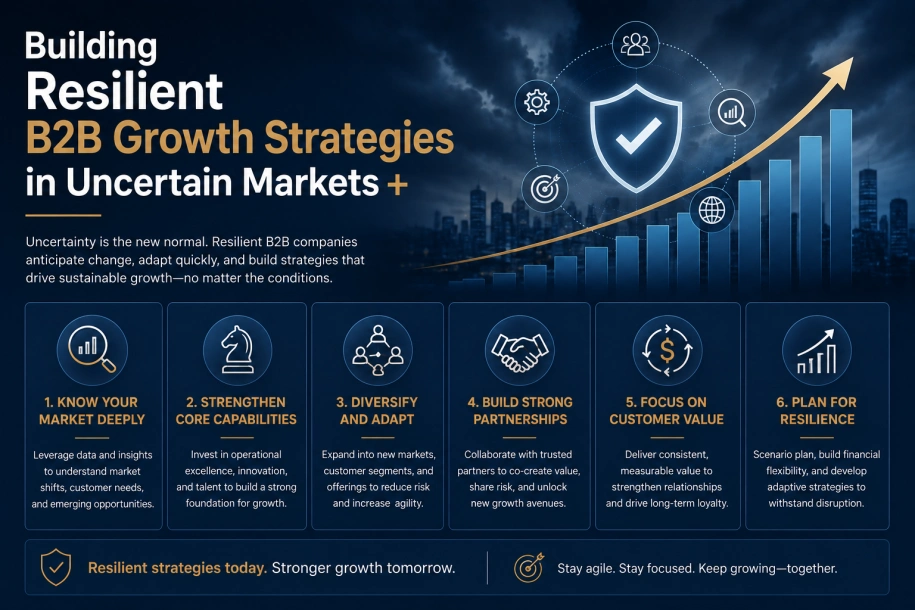
In today’s rapidly evolving business environment, organizations must develop strategies that remain effective even under volatile market conditions. Resilience is no longer optional—it is a core requirement for sustainable B2B growth. Successful companies focus on three foundational pillars: operational flexibility, diversified revenue streams, and data-driven decision-making. Operational flexibility allows businesses to adapt supply chains and resource allocation quickly when demand shifts. Diversifying revenue across multiple customer segments and geographies reduces dependence on any single market. Meanwhile, leveraging real-time data enables leadership teams to identify emerging risks and opportunities earlier than competitors. A practical approach begins with scenario planning. Organizations that regularly model best-case, base-case, and worst-case scenarios are better prepared to respond decisively. Equally important is fostering cross-functional collaboration so that strategy is not confined to the executive level but is understood and executed throughout the organization. Ultimately, resilient B2B strategies balance short-term agility with long-term vision. Companies that invest in both will be positioned to protect margins during downturns and capture disproportionate growth when markets recover.
Business Strategies
Sep 03, 2026